
You Did Everything Right. So, Why Is Growth Harder Now?
The tactics that got you to year three will not get you to year five. Your team is busy. The pipeline is thin. You are spending more and getting less. Not because your product is wrong. Because the system around your product was never built for where you are trying to go.
I have sat across from founders in exactly this spot. Smart people. Good businesses. Real traction. And the same problem, almost every time: the marketing that got them here was built for survival, not for scale. Those are two completely different things.
You built something real. Customers came. Revenue grew. For a while, it felt like momentum. Then it stopped working!
The Ceiling Nobody Warned You About
Early on, founder-led marketing works. You know the customer. You close rooms with your story. Referrals come in because people trust you personally. But that model has a hard ceiling.
When you drive every sales conversation, every relationship, and every piece of content, your growth stops where your capacity does. You cannot scale yourself. And when you try to hand it off without a clear system underneath, everything collapses.
The energy that built your early traction cannot be transferred to a team. It has to be turned into a process they can own, run, and improve without you watching.
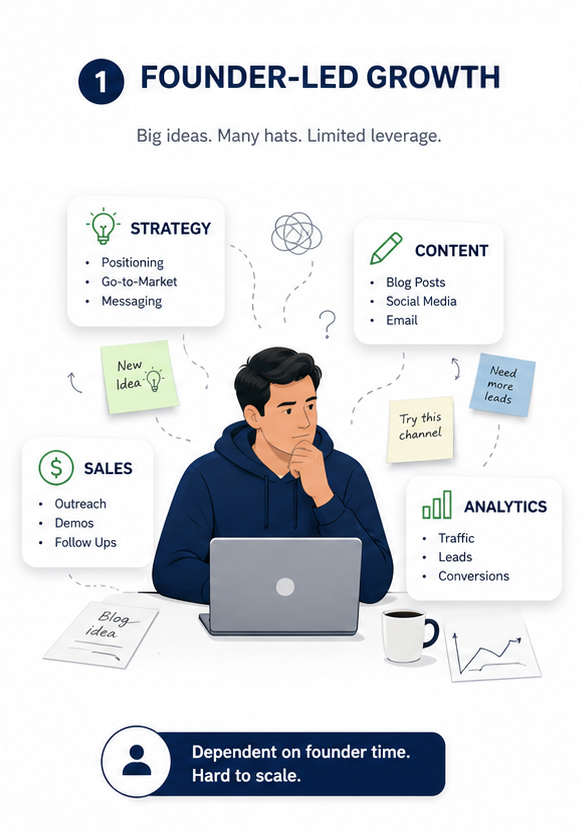
“The marketing that got them here was built for survival, not for scale.”
More Marketing Is Not the Solution
When growth slows, the instinct is to do more. More ads. More posts. More campaigns. Basically, wrong direction.
The OECD’s 2025 research on SME growth found that most struggling businesses are not lacking effort. They are lacking structure. The engine runs fine. The fuel line is broken.
Here is what that looks like in the real world:
- Inconsistent messaging that confuses buyers rather than converts them.
- No content strategy, so everything is created reactively, never intentionally.
- Too much paid media, with no organic foundation to support it.
- Marketing and sales operate separately, so leads arrive cold, and deals take forever.
- No real measurement, so nobody knows what is working or what is burning through the budget.
- Bursts of activity followed by silence. No compounding. No momentum.
These are system problems, but they are all fixable.
What the Reset Actually Looks Like
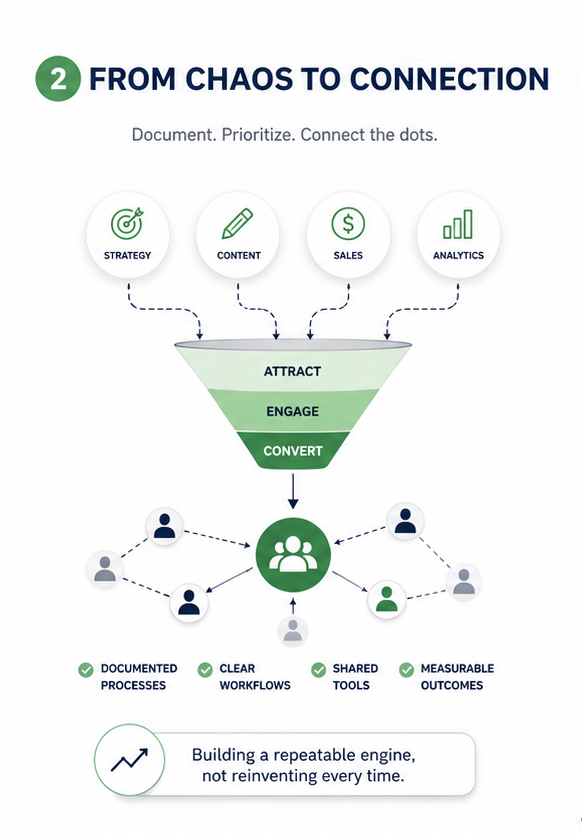
Scaling your marketing means building the infrastructure your early-stage hustle never needed, but your growth-stage business requires. Here is what that looks like, step by step:
1. Know Exactly Who You Are Selling To
Most founders think they know their audience. Yet most have never written it down with enough precision to hand it to someone else.
A real audience profile is not demographics. It is the specific problem your buyer is trying to solve, the words they use to describe it, what they have already tried, and the outcome they are actually paying for. Without that, your team fills the gap with assumptions. And those assumptions drift further from reality each quarter.
When you have true clarity about your buyer, every decision gets faster. Every campaign gets sharper. And every sales conversation takes less time.
2. Build a Content Engine, Not Just a Calendar
A content calendar tells you when to post. A content engine tells you why, for whom, and what each piece is supposed to do for the business. That difference matters more than most people realize.
Research in Harvard Business Review found that companies that scale build repeatable, structured systems. They do not just increase activity. Content is no different.
A proper content engine starts with a strong core piece. A long-form article, a detailed guide, or a practical breakdown. Then it distributes that thinking in formats that fit each platform. LinkedIn gets the strategic insight. Instagram gets the visual. Your email list gets the full context. Your website gets the SEO benefit.
Key idea: One well-researched article that answers a real question your buyer is already asking will outperform thirty rushed posts every time.
3. Turn Your Website Into a Growth Asset
Most small business websites are digital brochures. They describe what the company does, list the services, and sit there waiting for someone to show up.
That is not a marketing system. It is just a placeholder.
A scaled website functions as a lead-generation engine. It features SEO-optimized content that ranks for the terms your buyers search when they have the problem you solve. It provides clear paths for buyers at different stages of the decision process. It includes social proof that builds credibility before the first conversation. And it includes analytics that show where people drop off and why.
4. Connect Marketing and Sales Into One System
This is the most expensive gap I see in growing businesses.
Marketing creates awareness. Sales closes deals. But in between, leads quietly disappear. Prospects who showed interest but were never followed up. Conversations that went cold because the timing was off. Opportunities that slipped away because no one had a system to capture them.
A scaled growth system closes that gap on purpose. It defines what a qualified lead looks like before anyone starts generating them. It uses content to move buyers through the decision process before the sales call. It gives the sales team context so they can skip the basics and get straight to the conversation that matters.
5. Track the Numbers That Actually Matter
Reach. Impressions. Follower counts. They feel like progress. They are not.
Vanity metrics are comfortable because they are easy to produce. But if they are not tied to revenue, they are noise. A scaled marketing system tracks a short list of metrics: qualified leads generated, conversion rate from lead to meeting, cost per acquisition, and customer lifetime value. Everything else is context, not signal.
When you know those numbers, you make decisions with confidence. You double down on what works. You cut what does not. And you can talk about your marketing in the same language as your accountant. That kind of clarity is a competitive edge in itself.
BCG’s research on scaling ventures puts it plainly: companies that scale treat marketing and sales as a single integrated function, not as two departments with separate goals. When they run in silos, you pay for it with longer sales cycles and lower close rates.
The Founders Who Figure This Out
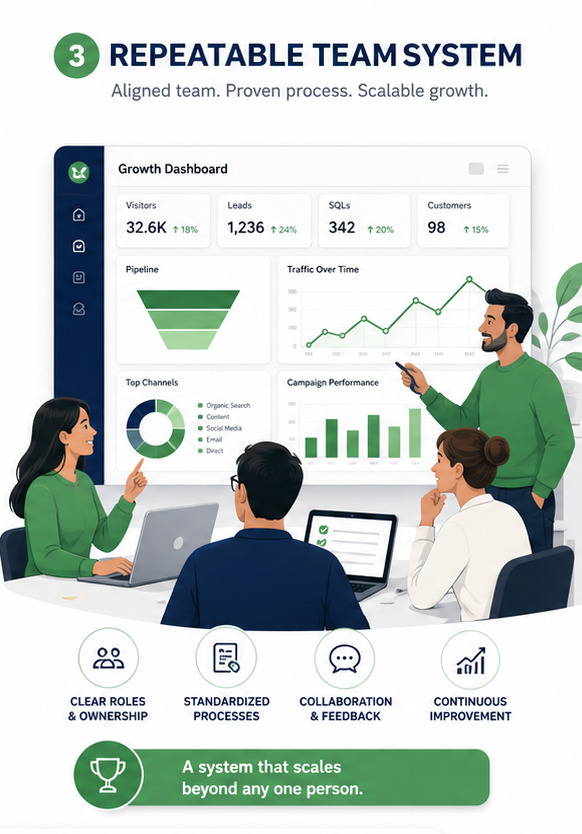
This is not about becoming a marketing expert. It is also not about hiring a big team or mastering every platform. It is about building a system that does not need you to run it, one that works perfectly with your hands off.
The founders who successfully grow beyond their ceiling are those who focus on the right strategies. They commit to a clear strategy, bring in the right people to execute it, and hold the whole thing accountable for business outcomes, not activity.
The ScaleUp Institute’s 2025 Annual Review found one trait that consistently appears in the fastest-growing SMEs: they invest in structured growth systems early, before the ceiling becomes a crisis. They build the infrastructure while the momentum is still there.
That is the shift. And it changes everything!
If You Recognize Your Business Here
Good! That is the first step. The next step is deciding you are done running the same plays and hoping for different results. Scale does not reward busy work. It rewards clarity, structure, and intention.
I have spent over two decades helping businesses grow, from early traction to sustainable, scalable revenue. Across industries and markets, the pattern holds: the companies that break through are not always the ones with the best product or the biggest budget. They are the ones who built the right system at the right time and stuck with it.
The wall you are hitting is not the end of your story. It is a signal that it is time to play a different game, one where strategy comes first and tactics follow.
If you are ready to build a marketing system that grows with your business, reach out directly. Or keep reading. Either way, the next step is yours.